How to Use a Trailing Stop in MetaTrader 5 (MT5)
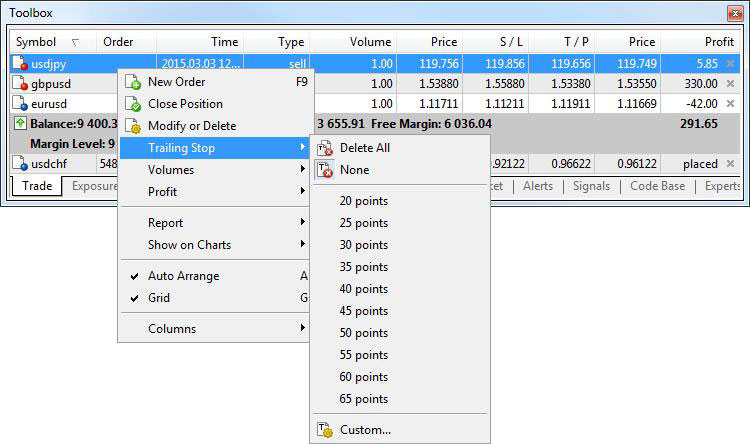
A trailing stop MT5 is a dynamic Stop Loss mechanism that automatically adjusts the Stop Loss as an open position moves in your favour. It maintains a configured distance from the current market price and does not move backward if the market reverses. On the MT5 desktop platform, you can set a native trailing stop by opening the Toolbox, going to the Trade tab, right-clicking the open position you want to manage, selecting Trailing Stop, and then choosing a preset or custom distance.
It's important to remember that a trailing stop doesn't guarantee a profit, nor does it fully eliminate market risk, slippage, or other execution-related risks.
How to Set a Trailing Stop in MT5?
Open MetaTrader 5.
Go to your Toolbox and select Trade.
Locate the open position you want to manage with a trailing stop.
Right-click on it.
Select Trailing Stop.
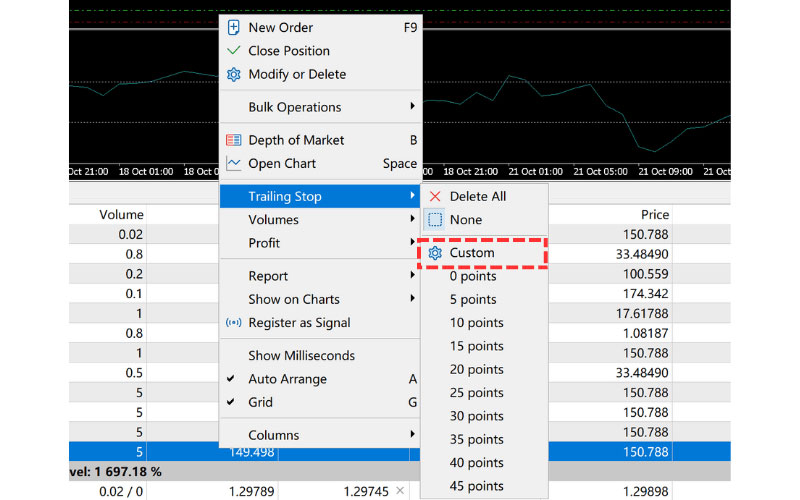
Choose either a preset distance or click on Custom.
Enter the desired distance in points.
Confirm your choice.
Key Takeaways:
Trailing stop MT5 automatically adjusts your Stop Loss based on a chosen distance.
Native MT5 trailing stops are typically configured in points rather than pips.
A trailing stop only moves in the direction of profit.
For the desktop trailing stop to work, the MT5 platform needs to be open and running.
Native MT5 trailing-stop processing is not necessarily updated continuously on every tick; MetaTrader documents a minimum processing interval for a position.
A very small trailing distance can make the Stop Loss more sensitive to ordinary price fluctuations.
What Is a Trailing Stop MT5?
A regular Stop Loss remains at the level you set unless it is manually modified. A trailing stop works differently: as an open position moves in a favourable direction, it can automatically adjust the Stop Loss while maintaining the configured distance from the current market price.
If the market reverses, the Stop Loss does not move backward. This means the trailing mechanism can only move the Stop Loss in the direction that improves the position's protection.
For example, if you bought EUR/USD and it goes up, your Stop Loss will move higher with it. If the price then starts to drop, your Stop Loss won't move back down with it. But remember, the ultimate outcome still depends on how the market behaves, the execution conditions, the spread, slippage, and how you've configured it. Even with a trailing stop, a position can still:
Be closed at a loss.
Be closed near break-even.
Experience slippage.
Not move far enough for the trailing mechanism to kick in.
So, a trailing stop is a tool for managing your trade, not a predictor of profits.
How Does a Trailing Stop Work in MT5?
According to MetaTrader 5's documentation, the platform monitors incoming price quotes. When your position becomes profitable and reaches a specific point relative to the trailing distance you've set, MT5 can send an order to move or set your Stop Loss at the desired distance from the current price.
Trailing Stop on a Buy Position
Let's use an illustrative example. Suppose you buy EUR/USD at 1.1000 and configure a trailing distance equivalent to 20 pips. If the market moves favourably to 1.1030, the trailing mechanism may adjust the Stop Loss to approximately 1.1010, depending on the configured distance, current price, quote precision, and MT5 platform rules.
If EUR/USD continues moving higher, the Stop Loss may continue adjusting upward according to the trailing settings. If the market then reverses, the Stop Loss will not move back down with the price.
Trailing Stop on a Sell Position
Again, this is only an illustrative example. Suppose you sell EUR/USD at 1.0850 and configure a trailing distance equivalent to 20 pips. If the market moves favourably to 1.0800, the Stop Loss may be adjusted to approximately 1.0820, depending on the configured trailing distance, current price, quote precision, and the platform's processing rules.
If the price continues falling, the Stop Loss may continue moving downward according to the trailing settings. If the market then reverses and rises, the Stop Loss does not move back up with the price.
When Does the MT5 Trailing Stop Start Moving?
A trailing stop may not modify the Stop Loss immediately after you set it. The trailing mechanism begins modifying the Stop Loss once the position has moved sufficiently in the favourable direction for the configured trailing distance to be applied.
This is why you may initially see no change in your Stop Loss level after enabling a trailing stop. Before assuming something is wrong, check the following:
Has the position moved enough in your favor?
Did you enter the distance correctly?
Did you use MT5 trailing stop points, not MT5 trailing stop pips, and do you know the difference?
Is your MT5 platform running and connected?
Native MT5 trailing-stop processing is not necessarily updated continuously on every market tick. MetaTrader documents a minimum processing interval for an individual position, which means the Stop Loss may not be modified every time the price changes.
MT5 Trailing Stop: Points vs. Pips
One common pitfall with MT5 trailing stops is understanding the difference between points and pips. By default, trailing stops are set using points. The relationship between points and pips varies depending on the financial instrument and its price precision.
For most 5-digit Forex pairs like EUR/USD:
Measurement | Example |
|---|---|
EUR/USD quote | 1.08543 |
1 point | 0.00001 |
1 standard pip | 0.00010 |
10 points | approximately 1 pip |
200 points | approximately 20 pips |
1 pip = 10 points
Therefore, for many 5-digit Forex quotes: 200 points = 20 pips
But this is not a universal rule! Metals, indices, cryptos, CFDs, and instruments with different decimal places might have different point/pip conversions. Before you set your MT5 trailing stop, make sure to check:
The quote precision of your symbol.
The contract specifications.
The instrument's point size.
A simple EUR/USD quote, like 1.08543, could be used to highlight one point versus one standard pip.
How to Set a Trailing Stop in MT5 Desktop?
The easiest way to set a native MetaTrader 5 trailing stop is through the desktop platform.
Log in to MetaTrader 5 with the correct trading account.
Make sure your Toolbox is open.
Select the Trade tab.
Find the open position you want to manage.
Right-click on the position.
Choose Trailing Stop from the menu that appears.
Select either one of the preset distances or click on Custom.
Enter your desired distance in points.
Confirm your selection.
Monitor your Stop Loss level to see if the trailing mechanism starts adjusting after the price moves in your favor.
If you would like to learn about the general MetaTrader platform, the MT5 trading platform could provide more insight.
Toolbox → Trade
Right-click position → Trailing Stop
Available preset distances
Custom distance dialog box
Stop Loss location once trailing goes into effect
How to Remove Trailing Stop MT5?
To remove a trailing stop from an open position,
Go to Toolbox → Trade
Right-click the relevant position
Select Trailing Stop
Then choose None
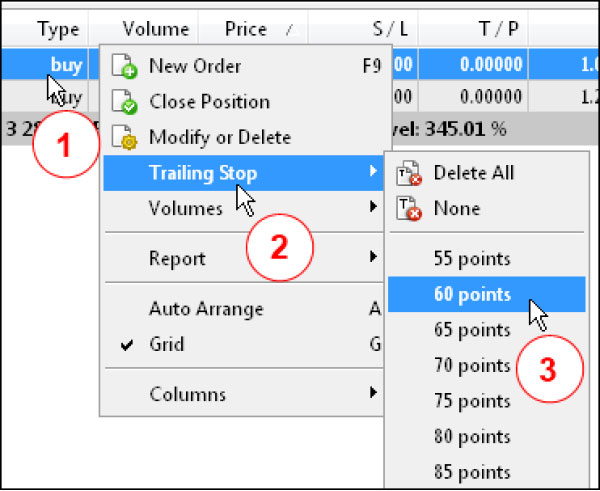
You can also use Delete All, where available, to disable applicable trailing-stop settings for multiple positions.
Does Removing the Trailing Stop Remove the Stop Loss?
Only in one particular aspect: removing the function means that it will no longer track the price. A Stop Loss level that was generated by a trailing stop will remain in place until it is repositioned or removed manually.
What Happens When MT5 Is Turned Off?
According to MetaTrader 5 documentation, the native Trailing Stop is executed in the trading platform rather than on the trading server. If the platform is not running, the trailing logic stops updating; however, the last Stop Loss level already sent to the server can still remain active. This means the trailing mechanism cannot continue updating if:
Your computer is turned off.
MT5 is closed.
Your computer loses its internet connection.
The MT5 terminal is no longer receiving the conditions required to process trailing-stop updates.
The last Stop Loss level set by the trailing mechanism remains in place unless it is manually changed or otherwise affected by the position being closed.
Is MT5 Trailing Stop Server-Side?
The standard native MT5 trailing stop is processed within the MetaTrader trading platform rather than on the trading server. Brokers may sometimes develop their own server-side technology for trailing.
It's essential not to conflate these differences. If you are using a broker's individual services or systems, check where and how the technology is provided.
Is a VPS Required for MT5 Trailing Stops?
Not necessarily. A VPS is mainly useful when you want the MetaTrader 5 terminal and any associated EAs to operate in a remotely hosted environment that reduces reliance on your local computer and internet connection.
It can be beneficial for ensuring the continued operation of MT5 so that trailing stops can continue to be maintained without requiring you to keep your home computer running while MT5 remains online. A Forex VPS does not guarantee profits or eliminate market, execution, or trading risks.
Can You Set a Trailing Stop on MT5 Mobile?
The current official MT5 mobile help documents manual Stop Loss and Take Profit modification, but does not document the same native desktop-style Trailing Stop workflow. Check the latest Android or iOS version and your broker-supported setup before assuming native trailing is available on mobile.
Trailing Stop vs Take Profit
A Take Profit aims to hit a pre-determined favourable price. A Trailing Stop allows the protective stop to move with price in favourable directions. In function:
Stop Loss: set a defined exit protection level.
Take Profit: sets a predefined price level at which an open position may be closed if the market reaches it.
Trailing Stop: dynamically adjusts the Stop Loss as price moves favourably.
In some trading setups and across different platforms, a position may consist of these three risk management mechanisms, which operate as parts of a larger trade management mechanism.
It is impossible to make absolute statements about one type of tool being “better” than the other in any environment.
Trailing Stop vs Fixed Stop Loss
Feature | Fixed Stop Loss | Trailing Stop |
|---|---|---|
Initial behaviour | Remains at a specified price | Uses dynamic trailing logic |
Moves automatically | No | Can move with favourable price movement |
Moves backward | No | No |
Platform dependency | Server-side Stop Loss remains active | Native trailing logic depends on the platform |
Main purpose | Define a protective exit level | Dynamically adjust a protective exit |
Depending on the trading style, a trader might still wish to set an initial Stop Loss and then use a trailing stop after favourable price movement occurs.
Trailing Stop vs Break-Even Stop
A break-even stop and a trailing stop are not one and the same. A break-even stop is an attempt to move the Stop Loss to the original entry price after specific trading conditions have been met.
A trailing stop will attempt to trail the stop in line with price and can move considerably as prices move favourably. A break-even position cannot be completely considered risk-free. Spreads, commissions, slippage, gaps, and market conditions can all influence the final outcome of a break-even position.
Tool | Main Function |
|---|---|
Take Profit | Targets a predetermined favourable price |
Break-even Stop | Moves protection toward the entry level |
Trailing Stop | Continues adjusting protection with favourable movement |
How to Choose a Trailing Stop Distance?
The correct distance will depend on the instrument, historical volatility, timeframe, and trading strategy. For instance, moving 20 pips on EUR/USD means something very different from doing so on Gold, a cryptocurrency CFD, an index, or GBP/JPY.
A universal setting, such as a 10-pip, 15-pip, or 30-pip rule for trading, shouldn’t be blindly followed – there are always multiple factors to consider, the most common one being whether you should apply the stop using a pip, point, and quote-symbol convention.
It can be helpful to evaluate a possible trailing stop distance on the instrument and within the framework of your strategy before deploying a setting to a live trading account.
Using ATR to Estimate a Trailing Stop Distance
ATR is one volatility measure that some traders use when testing possible trailing-stop distances. Here is a simple example:
ATR (Average True Range) = 20 pips
Proposed trailing stop distance = 1.5 × ATR
Calculation:
1.5 × 20 = 30 pips
This calculation is illustrative only. It does not suggest that 1.5 × ATR will always be suitable or that a trailing stop of 30 pips is always appropriate. The value should be reviewed based on market conditions, timeframe, instrument type, and the overall trading plan.
What Happens If a Trailing Stop Is Set Too Tightly?
A very tight trailing distance can make the Stop Loss more sensitive to ordinary market fluctuations, which may lead to earlier exits. It can also make the position more sensitive to spreads and short-term volatility.
Whether a tight trailing stop is appropriate depends on the instrument, market conditions, and the overall trading strategy.
What Happens If a Trailing Stop Is Too Wide?
A wider trailing stop gives the position more room to move against the prevailing direction before the Stop Loss is triggered. However, it can also allow a larger portion of unrealised gains to be given back if the market retraces or reverses.
Because the Stop Loss remains farther from the current price, the position may experience larger price fluctuations before the trailing stop is triggered. Whether this is appropriate depends on the instrument and the broader trading strategy.
Trailing Stops in Trending vs Ranging Market Conditions
The performance characteristics of a trailing stop will naturally differ under varying market conditions, from smooth trending to choppy or sideways movement.
Trending Market
During sustained directional price movement, a trailing stop can allow the position to remain open while the price continues moving favourably, with the Stop Loss adjusting according to the configured trailing distance.
Ranging or Choppy Market
In a choppy, consolidating, or sideways market, prices will see sharp reversals that can cause a trailing stop to trigger multiple times as positions are stopped out. A fixed trailing distance may produce different exit behaviour in trending and choppy conditions.
In sideways markets with frequent reversals, price fluctuations may trigger the Stop Loss sooner than they would during a sustained directional move.
Trailing Stops During High-Volatility Market Events
During significant events of unusually high market volatility, like a news release, for example, traders should be aware of several factors that may affect trailing-stop execution:
Prices can jump significantly and sometimes gap in the market.
Spreads can expand quite significantly, changing the execution environment in an instant.
Stop execution may occur at a price different from the requested Stop Loss level during fast-moving or gapping markets.
Note that this is not a definitive trading recommendation to avoid using trailing stops during news releases. There are significant factors at play, and this can differ considerably by broker, instrument, and the given market event.
It is advised to monitor economic releases and the potential impact of unusual volatility on the current trade management and exit rules.
Common MT5 Trailing Stop Problems
Even when a trailing stop is set correctly, it may not behave as expected due to platform settings, price movement, connectivity, or the way the distance is configured. The following are some of the most common issues you may encounter and what to check when troubleshooting them.
My Trailing Stop Isn’t Moving
There Could Be Several Reasons for This:
The price has not moved favourably by the number of pips or points set for moving the Stop Loss.
The parameters for the Trailing Stop haven’t been set correctly.
Points have been used rather than pips, or vice versa.
The MetaTrader 5 terminal program isn’t running.
There’s an internet connectivity issue.
An incorrect trade or position has been selected.
The symbol's trading conditions or minimum stop-distance requirements prevent the Stop Loss from being placed or modified.
The Position Was Closed Too Soon
This is not necessarily indicative of a problem with the trading platform; possible causes include:
The trailing distance is too tight for normal market volatility.
Increased market volatility or spread widening is occurring.
Execution issues on the part of the broker.
The set Trailing Stop settings were too strict for the ongoing market conditions or strategy.
Review the chart history and the Stop Loss information provided for the closed trade.
Trailing Stop Isn’t Available
Ensure the Following Apply:
You’re using MT5’s Desktop client (not mobile).
The relevant Position or Order is selected.
You’re running an up-to-date version of MT5.
Symbol- or broker-specific settings are not limiting you.
Don’t assume all brokers or platform versions have identical options or capabilities.
My Trailing Stop Distance Looks Wrong
Start by confirming whether the values are in pips or points, and double-check that the correct number of quote digits is associated with the currency pair or instrument type, along with the appropriate symbol contract specifications and the definition of a point for that symbol.
Does a Trailing Stop Guarantee Profit or Prevent Losses?
No. A trailing stop does not guarantee profit or prevent losses. A position can still close at a loss, experience slippage, or be affected by rapid market movements and execution conditions.
A trailing stop changes how the Stop Loss is managed; it does not predict future price movements or eliminate trading risk.
Native MT5 Trailing Stop vs. a Trailing Stop EA
The native MT5 trailing stop is a simple platform feature that uses a fixed distance. An Expert Advisor (EA), on the other hand, can implement more complex and customized trade management logic based on its programming.
For example, an EA can include activation thresholds, break-even logic, ATR-based calculations, candle-based conditions, and multi-position management. However, a custom EA isn't automatically better, as it introduces risks such as code, configuration, and software compatibility issues, along with the need for thorough testing.
It is good to know about manual trading vs automated trading. Most EAs also require an active execution environment unless you're using appropriate hosting.
Put Your MT5 Knowledge into Practice
A trailing stop can be a useful part of trade management when you understand how it works, how MT5 processes it, and how the selected distance fits your instrument and strategy. Rather than relying on a fixed number of pips, take the time to understand the platform's settings and test your approach in the conditions that matter to you.
If you want to use MetaTrader 5 with STP Trading, review the available account types and current trading conditions before choosing an account.